 Top Trending
The Listing Says 120 Milligrams of Ginkgo. The Label Says 10. What One Squeeze of This Purple Bottle Into Your Morning Coffee Gives You, by the Numbers.
It's a two-ounce squeeze bottle of unflavored electrolyte concentrate with three plant extracts, made in Los Angeles and sold three at a time. I read the panel, the listing, the trials behind each extract and a hundred reviews. The most useful thing in it isn't a herb. It's the reason it gives you to drink water.

This is a paid advertisement. Sponsored by Buoy Hydration, Inc.

Gordon Pratt is the pen name of this desk. The customers quoted on this page are real; their reviews are public on the seller's site and were read through the seller's own review system on September 5, 2026. I haven't met them and know nothing about them beyond what they wrote. The small photos beside their reviews are illustrations, not the reviewers. Everything about the product, from the ingredient panel to the return policy, comes from the seller's listing and policy pages, checked the same day.
Two numbers, and I want you to see both before I say anything else.
On the listing, in a paragraph about what each serving delivers, it says 120 milligrams of ginkgo.
On the Supplement Facts panel, behind a button that says "See Ingredients + Label," it says 10.
Not 120. Ten.
Twelve times less, in the same product, on the same page.
When a page and its own label disagree, I go with the label. The label is what's in the bottle.
I'm telling you this first because it decides how to read everything else about a squeeze bottle called Brain Health Drops.
Not with suspicion. With a calculator.
Here's what the bottle is.
Two fluid ounces of clear, unflavored liquid in a purple plastic bottle with a flip cap.
You squeeze it once into whatever you're drinking. Coffee, tea, water, whatever's in the mug.
Four to seven times a day, the label says, starting with your morning cup and stopping in the early afternoon.
Forty squeezes to a bottle. Sold three bottles at a time.
That's the whole product. No capsules, no scoop, no taste to speak of, or so the label says.
The reviews disagree a little, and I'll get to that.
I did what I always do.
I read the panel before the listing.
I read the trials behind each of the three extracts.
I read the shipping page and the return page, which matter more here than usual.
And I read every one of the hundred reviews the seller's system lets a stranger read.
What I found is a bottle that's mostly salt water with a whisper of three herbs, and the honest case for it has nothing to do with the herbs.
The two numbers120 on the Page, 10 on the Panel
Let me show you the panel, because the panel is the product.
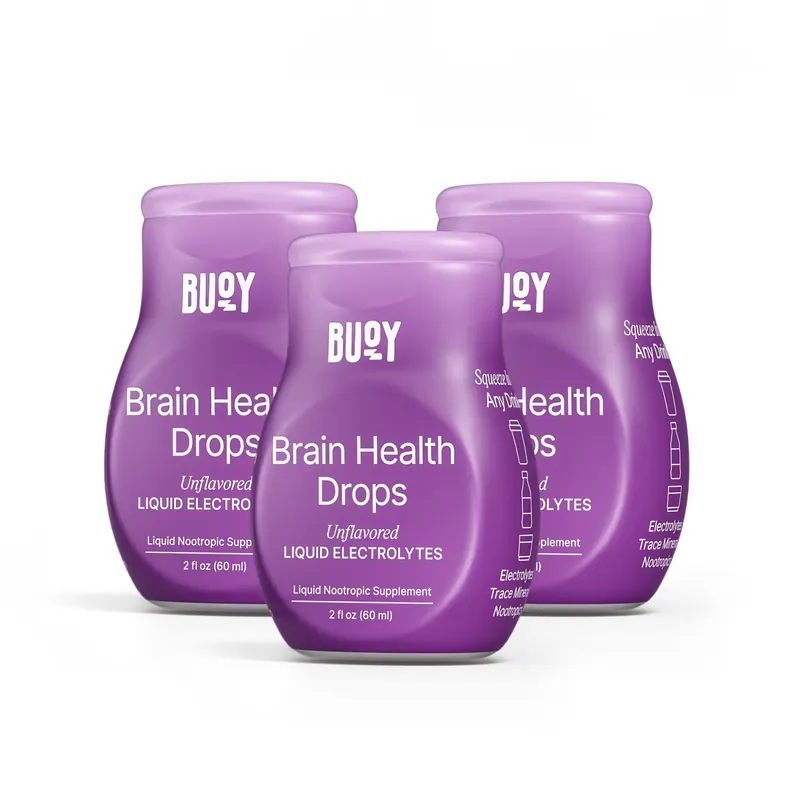
Serving size: one short squeeze, 1.5 milliliters.
Forty servings per bottle.
Under a heading that uses the fashionable marketing word for "brain boosters," which I won't repeat, three lines.
Ginseng root extract, 30 milligrams.
GABA, 30 milligrams.
Ginkgo biloba extract, 10 milligrams.
Then a second column, labeled "Recommended," for five squeezes a day.
150, 150 and 50.
So the most ginkgo you'll get in a day, following the label to the letter, is 50 milligrams.
The paragraph on the listing that says "120mg" per serving describes a bottle that, according to its own panel, doesn't exist.
I wrote to nobody about this. I'm not a watchdog. I'm a man with a calculator and a rule.
The rule is: the panel wins, every time, because the panel is what the law makes them print.
So from here on, the ginkgo in this bottle is 10 milligrams a squeeze.
Keep that in your pocket. It comes back.
The bottleTwo Ounces, Forty Squeezes, and No Sugar at All
This is what's on the counter.
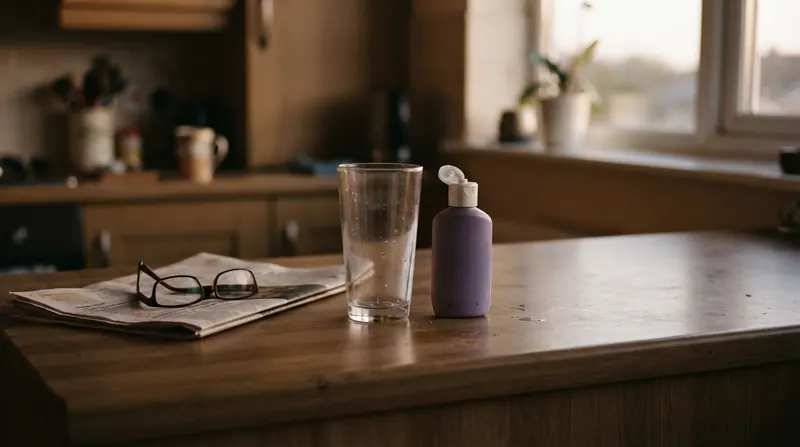
A soft purple plastic bottle you could lose in a coat pocket.
A white flip cap. A clear liquid inside.
The front says Brain Health Drops, then +Hydration, then Unflavored Beverage Enhancer.
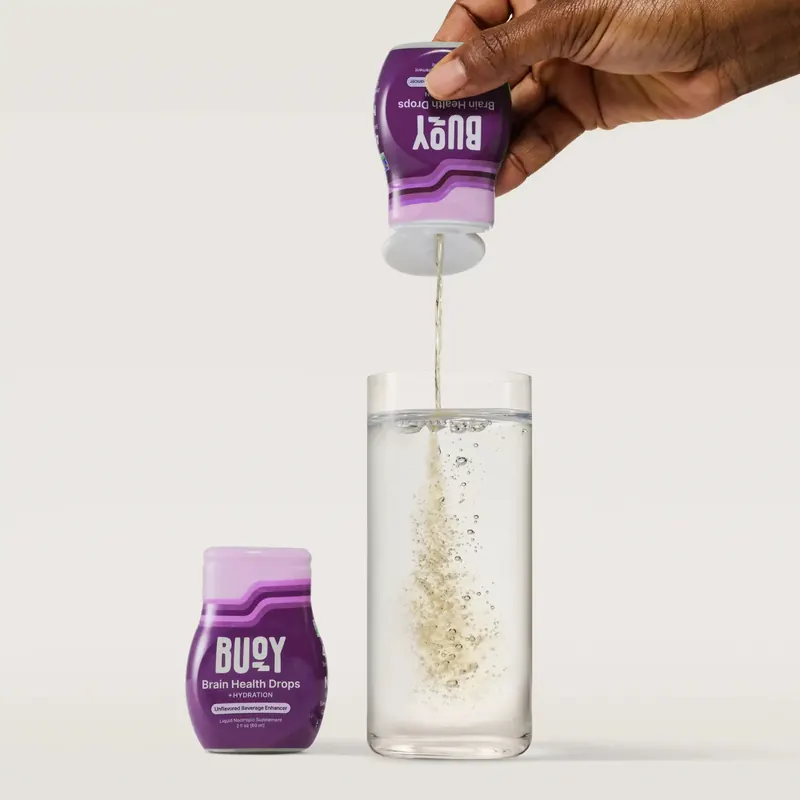
The panel says zero calories, zero carbohydrates, zero sugar.
No sweeteners, no flavors, no colors. That part checks out on the panel and in the reviews.
"Unflavored" is a stronger word than the reviews support.
Several people mention a taste. One says lemon water. One says the ginseng makes it "a bit bitter." Two say they're not fans.
The seller's own note explains why: a serving is 1.5 milliliters, and "if you notice a strong taste, you're squeezing too much."
So the instruction is a short squeeze, not a long one, and the bottle will tell you when you've overdone it.
Two more things off the page, and both are about money, so read them.
The seller sells this three bottles at a time, and the big button on the page is a subscription.
It ships every four weeks, at a lower price, until you stop it.
The one-time purchase is a smaller link underneath, at a higher price, and under the seller's free-shipping line it adds a flat shipping fee.
I'll come back to that in the section on where it's sold, because it decides whether you're buying a test or a habit.
The other thing is the company.
Buoy Hydration, Inc., with a street address in Los Angeles printed in its terms of service, and an email.
No phone number anywhere I could find. Support is by message.
That's less than I'd like and more than many bottles sold on the internet will tell you.
The arithmeticWhat 1.5 Milliliters Actually Holds
One squeeze. Here's everything in it, from the panel, in order.
- Ginseng root extract, 30 milligrams.
- GABA, 30 milligrams.
- Ginkgo leaf extract, 10 milligrams.
- Sodium, 50 milligrams, from sea salt. Two percent of a day.
- Chloride, 80 milligrams. Three percent.
- Potassium, 10 milligrams. Less than one percent.
- Magnesium and calcium, half a milligram each. A trace.
- A blend of "87+ trace minerals" from seawater, with no amount printed.
- Three B vitamins: B1, B6 and B5, at 30 to 40 percent of a day each.
- Water, citric acid, and a small antioxidant blend of blood orange, acacia, rosemary, anise and lime.
Multiply by five, the label's own "recommended" column, and you get the day.
150 of ginseng. 150 of GABA. 50 of ginkgo. 250 of sodium.
Hold onto those four numbers. Every trial below used one plant at a time, at several times these amounts, usually for weeks.
That's not a scandal. It's what a beverage enhancer is.
It's a way to put a little of something into water you were going to drink anyway.
Whether the little is enough is the question, and the arithmetic answers it plant by plant.
The honest partIt's Mostly Salt Water, and That's the Best Thing About It
Before the herbs, the salt, because the salt is where the real case lives.
Fifty milligrams of sodium is about what's in a slice of bread.
It's a third of what a serving of a sports drink carries, which is exactly what the label says.
Five squeezes a day is 250 milligrams, against a daily value of 2,300.
So this is not an electrolyte bomb. It's a pinch.
A pinch of salt in a glass of water makes the water taste like something, and a man drinks more of it. That's the whole mechanism, and it's a good one.

Here's why that matters more after 60 than it did at 40.
In a long-running study in Berlin, 1,111 adults aged 60 to 89 were tested over years.
A third of them were, by a blood measure, not drinking enough.
Those people declined faster on a test of thinking speed and on how they rated their own well-being, and the gap held after the researchers accounted for age, education and health. [1]
A 2021 review of 18 studies in 33,707 older adults found the same direction: people who ran dry did worse across the board, and there was some evidence, thin but consistent, of poorer thinking. [2]
Neither study tested a bottle. They tested water, or the lack of it.
And neither says the bottle does anything. They say that drinking enough does, and that men your age often don't.
That's the case I'll make for a squeeze bottle, and it's the only one the numbers allow.
Not that the herbs work. That you'll drink four glasses of water on a day you'd have drunk one, because the glass has a reason in it.
Extract oneGinseng: 30 Milligrams, and the Trials Used 200
First on the panel, and the one with the most research behind it.
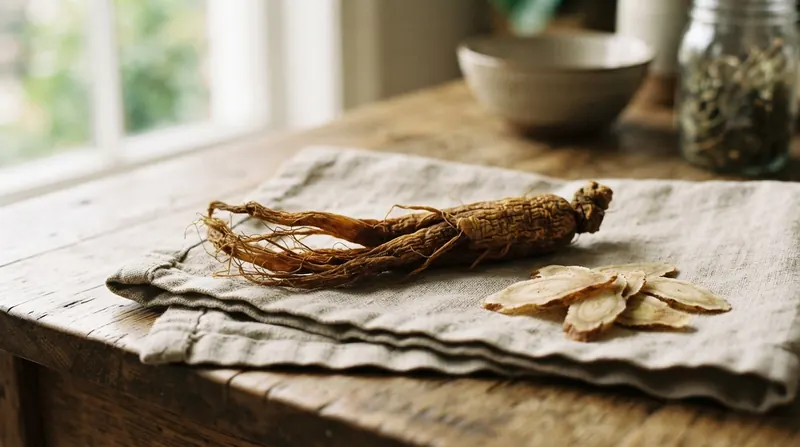
Asian ginseng is a slow-growing root from Korea and northeastern China with a long reputation as a tonic.
It has real trials. They're just not at this dose.
The biggest is a 14-week study of 256 healthy middle-aged volunteers.
They took a fixed combination, 100 milligrams of standardized ginseng extract with 60 of ginkgo, twice a day, or a placebo.
An overall index of memory quality improved by an average of 7.5 percent, and the gain held through the study and for two weeks after. [3]
In 30 healthy young adults, eight days of 200 or 400 milligrams a day went with feeling calmer, and at 400 with better mental arithmetic.
Taking it for a week added nothing over a single dose. [4]
And a single 200-milligram dose, in the same kind of volunteers, went with better performance on a subtraction task and less mental fatigue during an hour of hard mental work. [5]
Two hundred milligrams a day, of a standardized extract. This bottle gives you 30 a squeeze and 150 at five squeezes, of an extract whose standardization the panel doesn't state.
The National Institutes of Health sums the research up as modest benefits in middle-aged adults, not young ones, with the memory findings coming mostly from the combination with ginkgo.
That's fair, and it's also the ceiling.
Three cautions from the same government page, and I'd rather you heard them here.
Trouble sleeping is the most common side effect, which is one reason the label stops the squeezes in the early afternoon.
Ginseng may lower blood glucose and may interfere with clotting, so anyone who takes something daily for either should ask first.
And short-term use, up to six months, is what's considered safe; nobody has studied a decade of it.
Extract twoGABA: The Nervous System's Brake Pedal, With One Preliminary Study and a Big Question
Second on the panel, and the one I had to read most carefully.
GABA is the body's own brake-pedal messenger, a small amino acid your nerve cells make from another one.
Sold as a supplement, it's made by fermentation and marketed for focus and composure.
There's one usable trial.
Healthy young adults took 800 milligrams, or a placebo, and did a rapid visual attention test.
The GABA group made fewer ordering errors in one part of the test and no better on another.
The authors called it preliminary, and they raised, in their own paper, the question nobody has settled: whether swallowed GABA reaches the brain at all. [6]
A second trial from a related group, reporting better decision-making after 800 milligrams, was retracted in 2022.
I'm not citing it, and neither should anyone selling you GABA.
Eight hundred milligrams, once, in young adults, with an open question about whether it gets where it's going. This bottle gives you 30.
No trial has tested GABA for memory in people your age. Not one.
Read this line of the panel as a gesture toward composure, not as a dose of it.
Extract threeGinkgo: Ten Milligrams Against a Six-Year Trial
Third on the panel, at the number I told you to keep in your pocket.

Ginkgo is the plant everyone has heard of, and it has the biggest trial on this page.
Three thousand and sixty-nine adults aged 72 to 96 took a standardized extract, 120 milligrams twice a day, or a placebo, for a median of six years.
They declined at the same rate, in memory and in everything else measured. [7]
The National Institutes of Health says there's no conclusive evidence ginkgo helps with any health condition. [8]
There's a smaller, kinder study.
Ninety-three healthy adults aged 55 to 79 took 120 milligrams a day for twelve weeks.
On one kind of memory test, learning paired words, the ginkgo group did moderately better.
On every other measure, attention, executive function, mood, nothing. [9]
So the honest reading of ginkgo is: a large null at 240 a day, one positive test at 120 a day.
This bottle gives you 10 a squeeze, 50 a day at the label's maximum.
If 120 a day moved one test in twelve weeks, 50 a day is not going to move your afternoon.
And the caution, which doesn't shrink with the dose as much as you'd like.
Ginkgo can add to the effect of anything that thins the blood.
If you take something like that, or you have a procedure coming up, that's a question for your doctor before the first squeeze.
Here's where the three extracts leave us.
One root with real trials at seven times the dose. One brake-pedal molecule with a preliminary study at twenty-six times the dose and an unanswered question. One famous leaf that failed its big trial at twenty-four times the dose. And a pinch of salt.
The bottle is real. The panel is honest. The arithmetic says the herbs are a whisper and the water is the point.
The likelier explanationWhy a Man Drinks More When There's a Reason To
I'll tell you what I'd tell a friend who asked.
Most men over 60 I know drink coffee until noon and nothing until dinner.
Thirst gets quieter with age. The kettle doesn't.
By three o'clock the page you're reading swims a little, and you blame the page.

What actually helps is dull and free.
- Water on the bench, refilled every time you stand up.
- No coffee after two. The third cup fixes three o'clock and wrecks eleven.
- One thing at a time. Radio off while you read the manual.
- Ten minutes outside before the hard part of the day.
- Seven hours of sleep, or as close as you can get.
Now look at the first item and be honest.
You've been told to drink more water since your first physical, and you still don't.
Plain water is boring, and boring loses to coffee every time.
A bottle that gets you to drink four glasses of water is doing its main job before any herb shows up.
That's the sentence I'd put on the label if I made the label.
Not "brain." Not "cognitive." Just: this makes water taste like a reason, and men your age need a reason.

The reviewsA Hundred Reviews, Sorted the Way I'd Sort Them for a Friend
The seller's page shows 425 reviews with an average of 4.8.
Its review system lets a stranger read a hundred of them. I read all hundred.
Eighty-seven gave five stars. Thirteen gave four. None gave fewer.
Then I threw out more than half, and I'll tell you which.
I threw out every review that mentioned a medical condition, a medicine, a caregiver or a nurse, because a supplement page is no place for those.
I threw out the ones that credited the bottle with fixing something I can't check.
I threw out the ones that were only about the box arriving fast.
And I threw out two more from a reviewer whose third review I kept, because those two made claims the label doesn't.
What's left is the modest middle, which is where the truth usually lives.
These are real customers, quoted word for word from the seller's review system; the small photos beside them are illustrations, not the reviewers.

I like how these clear my mind up in the morning. It's like having a couple of cups of coffee for the alertness, but none of the jitters or anything else.

I usually lose focus around 3:30 or 4:00 in the afternoon. Traditionally, I've reached for caffeine, but I didn't like how jittery I was getting later in the night. I decided to try these Brain Health Drops. Happy to report more clarity and focus later in the afternoon without the extra caffeine!

They have been good, I like adding it to water and feeling like I'm drinking lemon water. And I have noticed some small differences in how I feel.

Really, I think i am more focused after only 3 weeks.

I like to put this one in my teas. Ginseng makes it a bit bitter, but I enjoy the medicinal qualities!

There is a flavor to this one. I'm not a fan of it, but it is manageable. I'll need to use it longer to see if I notice a difference in focus. I'll go back to the all-white drops after I get through these two bottles.
Read those the way I did.
Larry compares it to coffee without the jitters, which is a sentence about caffeine as much as about the bottle.
Brian gave four stars and said "small differences," which is the most careful phrase in the pile.
Rita wrote "I think," twice in one line, and I trust her more for it.
Laurie doesn't like the taste and hasn't noticed a difference yet, and she's still finishing the bottles, which is what an honest tester does.
Nobody in the reviews I kept claims anything big. Several say it changed what they drink. That's the effect I believe in.
What it isn'tSix Things a Squeeze of This Won't Do
- It won't give you 120 milligrams of ginkgo. The panel says 10, and the panel is the product.
- It won't act on any condition a doctor has named. It's salt water with three extracts, and the extracts are at a fraction of the doses anyone has tested.
- It won't replace the water. It goes in the water. If you squeeze it into coffee only, you've added a pinch of salt to your coffee.
- It won't be tasteless for everyone. The label says unflavored; four of the reviews I read disagree.
- It won't be a one-time test unless you click the smaller link. The big button is a subscription that ships every four weeks until you stop it.
- It won't come back for a refund unless it's your first order, you ask within thirty days of delivery, and you return whatever's unopened.
If that list annoys you, I'd rather you were annoyed now than when the second box arrives.
The routineIf You Do Buy It: Four Squeezes, Four Glasses, Fourteen Days
If you're going to spend the money, spend it as a test with a date on it, and test the thing that can actually work.

- Open one bottle. Leave the other two sealed. If it goes back, the sealed ones are what the seller wants.
- One short squeeze into your morning coffee. That's the label's own first serving, and it's the one you'll never forget.
- Then three squeezes into three glasses of water: mid-morning, lunch, mid-afternoon. Not into more coffee.
- Nothing after two o'clock. The label stops in the early afternoon, and the ginseng page says why: sleep.
- Count the glasses, not the squeezes. The glasses are the point. Four a day is the number to hit.
- No coffee after two, water on the bench, radio off while you read. Do these for the same fourteen days, so the test is a real one.
- On day fourteen, ask one question: did I drink more water than the fourteen days before? If yes, the bottle earned its keep. If no, nothing in it will save it.
Look at that list the way I do.
Five of the seven things are free.
The bottle is the one you'll pay for, and the tap is the one that will do the work.
Four glasses a day is a small thing to keep. Keep the count, or you'll never know which of the two did it.
Who it's forWho It Suits, and Who It Doesn't
This is worth a look if:
- You drink coffee all morning and almost no water, and you know it.
- You can't stand sweet sports drinks and want water to taste like something without sugar.
- You want the whole panel and a company with a street address, and you've now seen both.
- You can hold two ideas at once: real extracts, at doses far below the trials.
- You'll run it as a fourteen-day test counting glasses, not as a hope.
Give it a miss if:
- You want something that acts on a condition a doctor has named. This is a beverage enhancer.
- Your doctor has asked you to limit sodium. Five squeezes add 250 milligrams a day, and you'd want to count them.
- You take anything that thins the blood, or anything for your glucose. Ginkgo and ginseng are both on the panel. Ask first.
- You sleep badly already. Ginseng's most common side effect is trouble sleeping, and the label's afternoon cutoff exists for a reason.
- You're pregnant or nursing. The seller's page says it's fine; the National Institutes of Health says ask a doctor before taking ginseng. Ask.
- You don't want a subscription. The one-time purchase exists, but it's the smaller link, at a higher price, plus shipping.
Where it's soldFrom Los Angeles, Three Bottles at a Time, With Two Buttons and One Guarantee
The bottles are sold by Buoy on its own website.
That's the only place this page links to.
The current prices are shown there, not here.
What I'll tell you is the shape of the offer, because the shape matters more than the price.
First, the two buttons.
The big one is a subscription: three bottles every four weeks, at a discount, with free shipping, until you cancel from your account.
The small link under it is a one-time purchase of the same three bottles, at the full price, and if the order is under the seller's free-shipping line it adds a flat shipping charge.
If you want a test, click the small link. If you want a habit, the big one is cheaper, and you can cancel it in the portal any time before the next box.
Second, shipping. Orders placed before eight in the morning Central go out the same business day; later ones the next.
The seller says three to four business days by USPS, FedEx, UPS or DHL, and that 95 percent arrive within seven.
Third, the guarantee. Read this twice.
It's called "30-Day Try Risk-Free," and it's real, but narrow.
It applies to a new customer's first order only.
You have to ask within thirty days of delivery, through the seller's help center, and send back everything unopened with the prepaid label they give you.
Refunds go to the original card within about a week of the box arriving back.
Outside that, and outside damage in shipping, which they replace with a photo, all sales are final.
Once an order is placed it can't be changed or cancelled, so check the address before you click.
Everything in a squeeze
| Ingredient | Amount per serving |
|---|---|
| Panax ginseng root extract | 30 mg per 1.5 ml serving (150 mg per 5) |
| GABA (gamma-aminobutyric acid) | 30 mg per serving (150 mg per 5) |
| Ginkgo biloba leaf extract | 10 mg per serving (50 mg per 5) |
| Sodium and chloride (as sea minerals) | 50 mg sodium (2% DV) and 80 mg chloride (3% DV) per serving |
| Potassium (as potassium citrate) | 10 mg per serving (<1% DV) |
| Magnesium and calcium (as sea minerals) | 0.5 mg each per serving (<1% DV) |
| 87+ ionic trace minerals (proprietary blend: manganese, boron, selenium, silica, copper and others) | — (amount not stated) |
| Vitamin B1 (thiamin HCl) | 0.5 mg per serving (40% DV) |
| Vitamin B6 (pyridoxine HCl) | 0.5 mg per serving (30% DV) |
| Vitamin B5 (pantothenic acid) | 1.5 mg per serving (30% DV) |
Full details on each ingredient are in the guide linked at the bottom of this page.
The ingredient and advertising guide linked at the foot of this page goes through every line of the panel.
What it is. What the research does and doesn't show. What to be careful about. And which of our own headlines it does and doesn't support.
Print it and take it to the pharmacist if you take anything daily. It's written for that.
See the current price on the seller's site
Unflavored liquid electrolyte drops with three plant extracts (ginseng, GABA and a little ginkgo), squeezed into four to seven drinks a day, in a two-ounce bottle sold in packs of three.
CHECK AVAILABILITYSold and shipped from the US by Buoy Hydration, Inc., Los Angeles · Subscription and one-time purchase are two separate buttons on the seller's page · 30-day refund on a new customer's first order only, with unopened items returned; otherwise all sales are final
QuestionsWhat Readers Ask Me Before Their First Bottle
Questions readers ask
Is this medicine?
No. It's a liquid dietary supplement, a beverage enhancer made in the US with sea minerals, three B vitamins and three plant extracts. The seller's site carries the standard sentence about what it isn't intended for, and the FDA hasn't evaluated the claims on the listing.
Why does the page say 120 milligrams of ginkgo and the panel say 10?
I don't know, and I wrote to no one to find out. The Supplement Facts panel says 10 milligrams per 1.5-milliliter squeeze and 50 per five squeezes. I go by the panel, because the panel is what the law requires them to print and what's in the bottle.
Does it have caffeine?
No. Nothing on the panel is caffeine, and the seller says its only caffeinated product is a different one. The alertness people describe in reviews mostly comes from the coffee they squeeze it into.
What does it taste like?
The label says unflavored. Reviewers describe faint lemon, or a slight bitterness from the ginseng, and two say they don't like it. The seller's note says a strong taste means you squeezed too much; a serving is 1.5 milliliters.
How long does a bottle last?
Forty squeezes. At four a day, ten days; at seven, under six. Three bottles at the label's own four to seven a day is seventeen to thirty days, not the "one-month supply" the listing calls it unless you stay at the low end.
Will it help my memory or focus?
I can't tell you that, and you should be wary of any page that does. Ginseng has real trials at 200 milligrams a day, and this gives 30 a squeeze. Ginkgo failed its big trial at 240 a day, and this gives 10. What it reliably does is make a glass of water taste like something, and drinking enough water is one of the few things on this page with evidence behind it in people over 60.
Can I take it alongside what I already take?
Ask your doctor or pharmacist and take the ingredient guide with you. Ginkgo can thin the blood, ginseng can lower blood glucose and affect clotting, and the sodium counts if you're limiting salt. Two minutes at the pharmacy counter answers all of that.
Is the subscription hard to cancel?
The seller says you can pause or cancel any time from your account portal or by message, and that it sends a reminder up to five days before the first recurring order. Orders already created can't be cancelled, so cancel before the reminder, not after the box ships.
What if it arrives and I don't like it?
If it's your first order, ask for a refund within thirty days of delivery through the seller's help center and send back what's unopened with their prepaid label. Open one bottle, not three. Outside that first-order guarantee, all sales are final.
Is there a bigger pack?
Yes. The seller also lists nine bottles with free shipping. Don't buy nine to test something; buy three, open one.
The short versionEverything Above, in Sixty Seconds
- A purple two-ounce squeeze bottle of unflavored electrolyte drops from Buoy Hydration in Los Angeles, with a street address and an email in print and no phone.
- One short squeeze, 1.5 milliliters, into four to seven drinks a day, morning cup to early afternoon. Forty squeezes a bottle, sold three at a time.
- Per squeeze: 30 milligrams of ginseng, 30 of GABA, 10 of ginkgo, 50 of sodium, 80 of chloride, 10 of potassium, three B vitamins and an unmeasured trace-mineral blend. Zero sugar.
- The listing says 120 milligrams of ginkgo per serving. The panel says 10. The panel wins.
- Ginseng has trials at 200 to 400 milligrams a day. [4] [5] GABA has one preliminary study at 800. [6] Ginkgo failed its six-year trial at 240. [7] None of that is in a squeeze.
- Not drinking enough is linked, in older adults, to faster decline in thinking speed and well-being. [1] That's the case for a bottle that makes you drink.
- A hundred readable reviews, mostly five stars; the ones worth trusting say "small differences" and "I think."
- Big button is a subscription; small link is one-time. Refund only on a first order, within thirty days, unopened items returned. Otherwise final.
The answerWhat a Squeeze Is Actually Worth
Here's the whole thing in one breath.
Ten milligrams of ginkgo, not 120.
A whisper of ginseng, a gesture of GABA, and a pinch of sea salt.
In a bottle that fits in a coat pocket and turns a glass of tap water into something you'll finish.
If you're a man who drinks coffee till noon and nothing till dinner, that last line is worth more than the first three.
Not because of what's in the squeeze. Because of what's in the glass.
Buy three, open one, count the glasses for fourteen days, and let the count decide. It's a better judge than I am.
Check the current price and availability
Unflavored liquid electrolyte drops with three plant extracts (ginseng, GABA and a little ginkgo), squeezed into four to seven drinks a day, in a two-ounce bottle sold in packs of three.
CHECK AVAILABILITYSold and shipped from the US by Buoy Hydration, Inc., Los Angeles · Subscription and one-time purchase are two separate buttons on the seller's page · 30-day refund on a new customer's first order only, with unopened items returned; otherwise all sales are final
P.S. If you take one thing from this page, take the two numbers. The listing says 120 milligrams of ginkgo a serving; the panel says 10. Everything else about this bottle follows from choosing which one to believe, and the law already chose for you.
P.P.S. If the afternoon fog has been with you for a year, and it's there in the morning too, talk to your doctor before you buy anything. A squeeze bottle is a small habit. It was never going to answer a question a doctor answers in fifteen minutes.
P.P.P.S. And if you do order it, put the bottle next to the tap, not next to the coffee maker. The whole case for this bottle is the water you'll drink because of it, and a bottle by the coffee maker just makes salty coffee.